Welcome to "You and Nigeria Electricity" Blog

Your best source of current and relevant information/Breaking News impacting on Nigeria Electricity Supply Industry, West Africa, Africa and the entire world


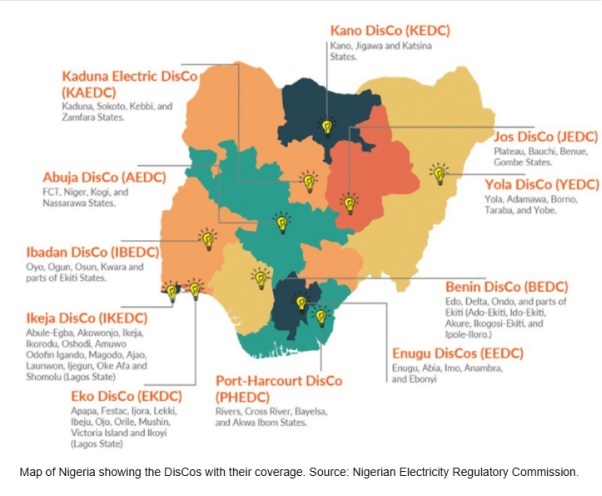
Geographical Spread of the Nigeria Electricity Distribution Companies

10 December, 2025 at 10:00


Nigeria’s electricity supply system was originally divided into 11 Distribution Companies (DisCos) under the Electric Power Sector Reform Act of 2005. Each company was assigned responsibility for specific states and regions across the country. With the introduction of the Electricity Act of 2023, both private companies and state governments are now permitted to participate in electricity distribution. Taking advantage of this new opportunity, Aba Power Limited Electric (APLE) began operations in 2024, making it the 12th electricity distribution company in Nigeria.

Below is the geographical coverage of all 12 DisCos across the nation.
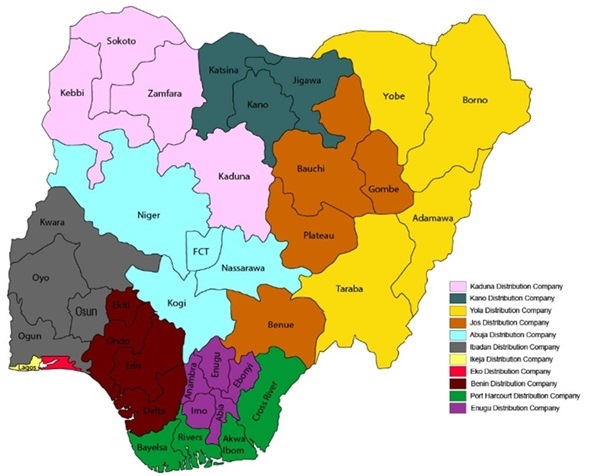


11 Earlier Distribution Companies

11 Earlier Distribution Companies: Source: https://nbet.com.ng/distmap.html


Abuja Electricity Distribution Company (AEDC) is responsible for electricity supply across Central Nigeria, covering the Federal Capital Territory (FCT), Niger, Kogi, and Nasarawa States. It currently serves over 1.29 million registered customers in these areas.
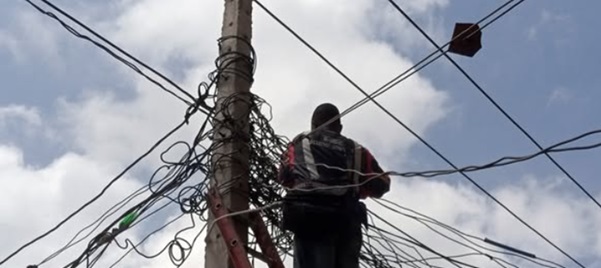


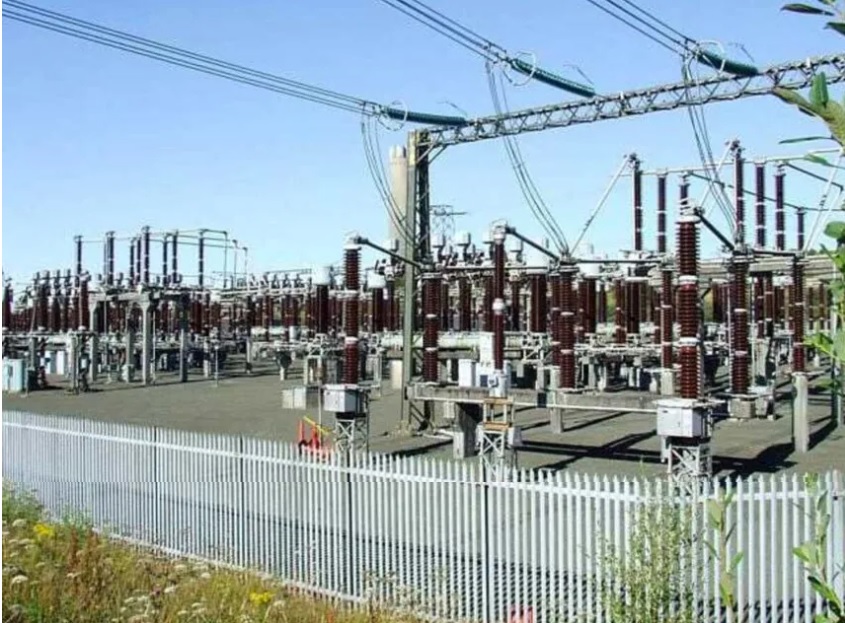
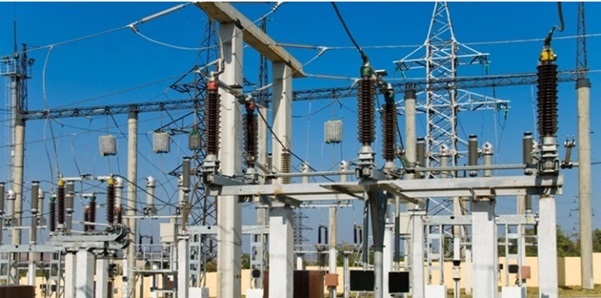
Electricity Distribution Maintenance Man

Maintenance man at work


Benin Electricity Distribution Company (BEDC) is responsible for electricity supply across Southern Nigeria, covering the states of Edo, Delta, Ondo, and Ekiti. It manages a large service area and provides power to over 1.46 million registered customers as of Q1 2025.

Eko Electricity Distribution Company (EKEDC) manages electricity supply across Lagos South (including Ojo, Festac, Apapa, Lekki, and surrounding areas) as well as parts of Ogun State. It is one of Nigeria’s largest power distributors, serving about 752,974 registered customers. Key service areas include Lekki, Ibeju, the Islands, Ajah, Ajele, Orile, Ijora, Apapa, Mushin, Festac, Ojo, and Agbara (Ogun State).

Enugu Electricity Distribution Company (EEDC) is responsible for electricity distribution across the five states of Southeast Nigeria: Enugu, Abia, Imo, Anambra, and Ebonyi. As of Q1 2025, it serves over 1.39 million registered customers in this region.
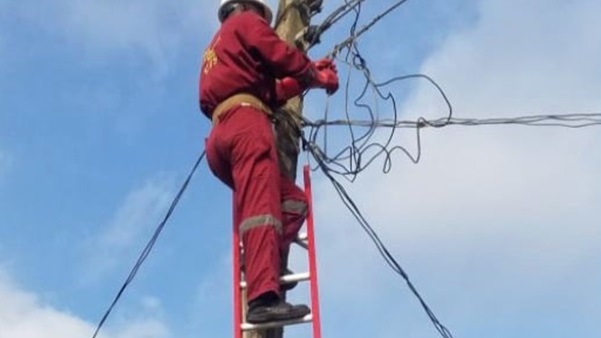


Electricity Distribution Maintenance Man

Maintenance Officer fixing a broken conductor


Ibadan Electricity Distribution Company (IBEDC)operates across Southwestern Nigeria, covering Oyo, Ogun, Osun, Kwara, and parts of Ekiti and Kogi States. It is Nigeria’s largest power distribution company, serving over 2.69 million registered customers as of Q1 2025.

Ikeja Electric (IKEDC)supplies electricity to major districts in Lagos State, including Ikeja, Agege, Ikorodu, Abule Egba, Akowonjo, Oshodi, Apapa, Lekki, and Shomolu. It is one of Nigeria’s largest electricity distributors, with over 1.31 million registered customers as of Q1 2025.

Jos Electricity Distribution Company (JEDC)is responsible for electricity distribution in Central Nigeria, covering Plateau, Bauchi, Benue, and Gombe States. It serves approximately 857,562 registered customers.

Kaduna Electric (KAEDC)operates in Northwestern Nigeria, supplying power to Kaduna, Sokoto, Kebbi, and Zamfara States. It has about 889,146 registered customers.
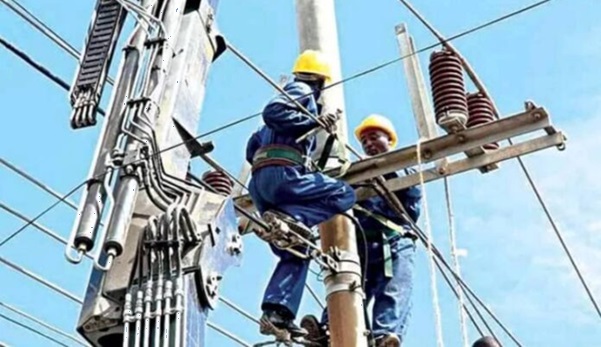


Electricity Distribution Maintenance Men

Electricity Distribution maintenance men at work


Kano Electricity Distribution Company (KEDC)supplies electricity across Northern Nigeria, covering Kano, Jigawa, and Katsina States. It serves approximately 887,554 registered customers.

Port Harcourt Electricity Distribution Company (PHEDC)operates in Southern Nigeria, providing electricity to the states of Rivers, Cross River, Bayelsa, and Akwa Ibom. It serves over 1.17 million registered customers.

Yola Electricity Distribution Company (YEDC)is responsible for electricity distribution in Northeastern Nigeria, covering Adamawa, Borno, Taraba, and Yobe States. It serves about 824,693 registered customers.
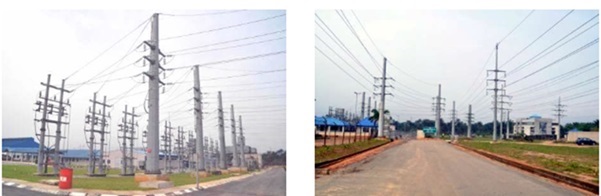


Aba Power Limited Electric Distribution Network

Aba Power Limited Electric distribution network. Source: https://geometricpower.com/aple/


Aba Power Limited Electric (APLE)runs Nigeria’s first independent electricity distribution network, located in the Aba Ring‑Fence Area (ARFA). It is part of the Aba Integrated Power Project, which is connected to the 141 MW Geometric Power Plant.
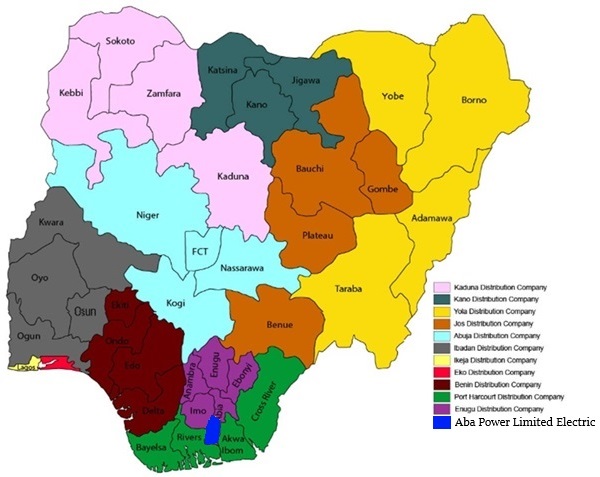


Aba Power Limited Electric Service Coverage

Nigeria 12 Electricity Distribution Companies including Aba Power Limited Electric/


Under its license, APLE supplies electricity to 9 out of 17 Local Government Areas (LGAs) in Abia State, serving 210,911 registered customers as of Q1 2025.


Next Article
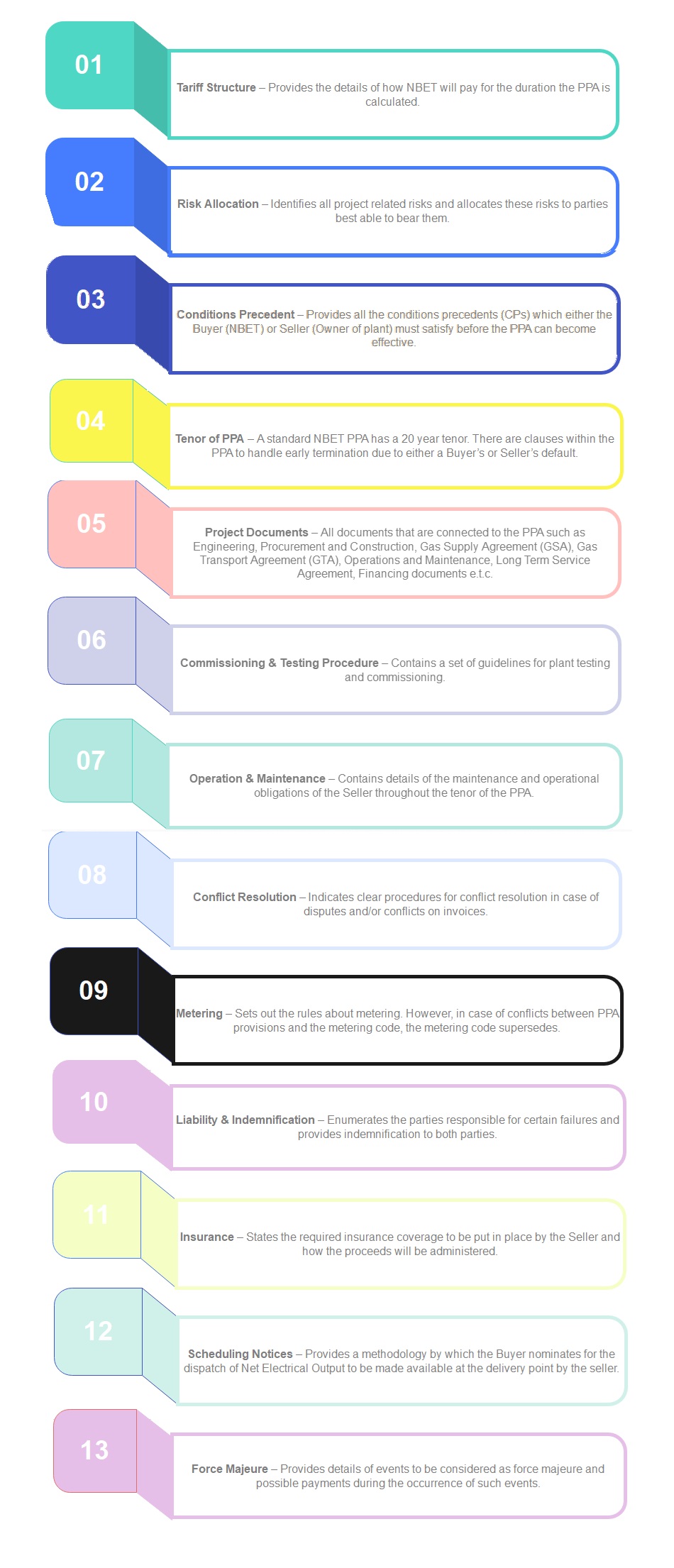


NBET’s Outline of the Key Parts of a Power Purchase Agreement

7 December, 2025 at 09:00


The Nigerian Bulk Electricity Trading Plc (NBET) is Nigeria’s bulk electricity trader whose roles were listed in Electric Power Sector Reform Act of 2005 (Sections 25 and 68) and renewed in the electricity Act, 2023, sections 6f and 7(2)d. The Nigerian Bulk Electricity Trading (NBET) Plc. is the manager and administrator of the electricity pool (‘The Pool’) in the Nigerian electricity supply industry (NESI). Here are the key parts of the Power Purchase Agreement between NBET (Electricity Buyer) and the Electricity Producer (Seller) as listed in NBET Web site: : https://nbet.com.ng/partppa.html


Key Parts of a Power Purchase Agreement

Next Article


Common Types of Power Purchase Agreement

29 November, 2025 at 10:00


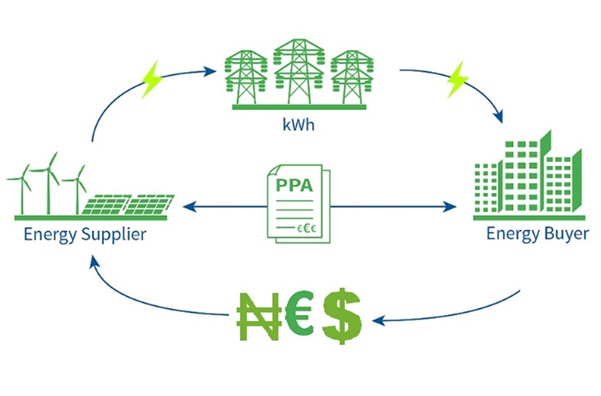
PPA Contract Flow

Typical Power Purchase Agreement Contract Flow: Source: Adapted from https://resource-platform.eu/what-are-ppas


A power purchase agreement (PPA) is a long-term contract between an electricity generator and a buyer for the sale of electricity, typically from renewable sources like solar or wind. These agreements provide financial stability by locking in a price for a fixed period, which helps both the project developer secure financing and the buyer hedge against volatile market prices. PPAs are crucial for large-scale renewable energy projects and for corporate buyers aiming to achieve sustainability goals.

Key components and benefits

  • Contractual agreement: A PPA is a legal contract that governs the sale and purchase of electricity between an energy generator (seller) and a buyer, such as a utility or a corporation.
  • Price and volume certainty: The contract sets a fixed price for a defined volume of electricity over a set period, often 5 to 20 years.
  • Risk mitigation: For the buyer, it provides price stability and removes exposure to short-term market volatility. For the seller, it provides a guaranteed revenue stream, which is essential for securing financing for project development.
  • Enables renewable energy projects: PPAs are a key tool for financing and building large-scale renewable energy projects by providing a bankable revenue stream for investors.
  • Supports sustainability goals: Corporate buyers use PPAs to meet sustainability targets, lower their carbon footprint, and improve their green image by supporting the development of new renewable energy sources.
  • There are different kinds of PPAs. The main ones are explained below.


1. An On-Site PPA

An on-site Power Purchase Agreement (PPA) is a long-term contract between a business (the customer) and a renewable energy developer. Instead of the business buying and installing solar panels or other renewable systems themselves, the developer takes care of everything—owning, financing, building, and running the system. The business simply agrees to buy the electricity the system produces, usually at a stable, predictable price.

Think of it like leasing space on your roof or car park to a solar company. They put up the panels, keep them working, and you get cheaper, greener electricity without the headache of managing the system.


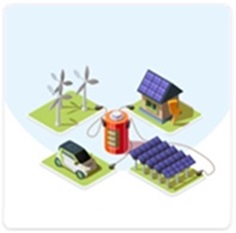
On Site PPA

On Site PPA Source: https://www.smartcommercialsolar.com.au/resources/3-types-of-ppas-explained


How It Works

  • Installation on-site: The developer sets up renewable energy equipment (like solar panels) directly on the customer’s property—on rooftops, parking lots, or open land.
  • Buying electricity: The customer pays only for the electricity generated, often at a fixed rate that’s lower than what they’d pay to the utility grid.
  • Developer responsibility: The developer designs, builds, finances, and maintains the system. They take on the financial and operational risks.
  • Immediate savings: From day one, the customer’s electricity bill can drop, since they don’t pay upfront for the system.
  • Long-term contract: Agreements typically last 15–25 years, giving businesses stable energy prices over decades.

Key Benefits

💰 Cost savings: Lower electricity bills thanks to predictable, fixed rates.
🚫 No upfront cost: The business avoids the large expense of buying and installing solar panels.
🛡️ Reduced risk: The developer handles all technical and financial challenges.
♻️ Sustainability: Companies can meet green energy goals by using clean, renewable power.
🔒 Energy security: Generating electricity on-site makes supply more reliable and less dependent on external grid fluctuations


2. An Off-site PPA

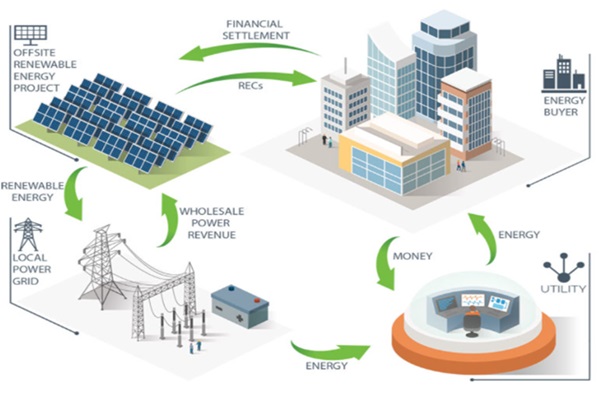
An off-site PPA is a long-term deal (often 10–25 years) where a company agrees to buy renewable energy (like solar or wind) from a power plant that is not located on their property. The electricity is sent through the public grid before reaching the company.


Off Site PPA

Off-Site and Virtual PPA. Source: https://artpictures.club/autumn-2023.html


Key Points

  • Flexible Location: The power plant can be built where conditions are best (lots of sun or strong wind), not limited to the company’s site.
  • Grid Delivery: Energy goes into the main grid first, then reaches the company like normal electricity.
  • Third-Party Ownership: A developer owns and runs the plant; the company just buys the energy.
  • Large Scale: Best suited for big projects, helping large companies meet sustainability goals.
  • Stable Prices: The contract usually sets a fixed or predictable price, protecting against market swings.

3. Corporate PPA


Corporate PPA

Corporate PPA Source: https://futureenergygo.com/different-types-of-power-purchase-agreements-ppas


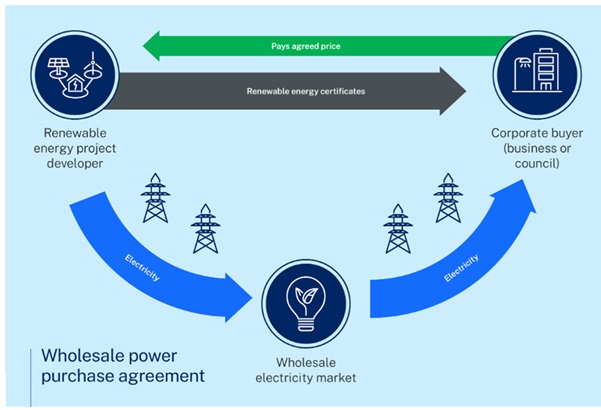
A Corporate Power Purchase Agreement (PPA) is a long-term deal—usually lasting 10 to 20 years—between a company and an energy provider (like a solar or wind farm developer). The company agrees to buy renewable electricity, helping fund clean energy projects while locking in predictable energy costs.


Corporate PPA

Wholesale power purchase agreements are between energy users and the project developers. Source: https://www.energyco.nsw.gov.au/ppa-explainer


Benefits of Corporate PPAs

  • Stable Pricing: PPAs offer fixed or predictable electricity rates, protecting companies from market price swings.
  • Sustainability Goals: They help businesses meet climate targets and ESG commitments (like RE100 or CDP).
  • No Capital Needed: Companies can use renewable energy without building or maintaining their own power plants.
  • Lower Risk: The developer handles the technical and operational risks of running the power facility.
  • Proof of Green Energy: Each unit of electricity comes with a certificate (like RECs or GOs) to verify it’s renewable.


4. Sleeved PPA


Sleeved PPA

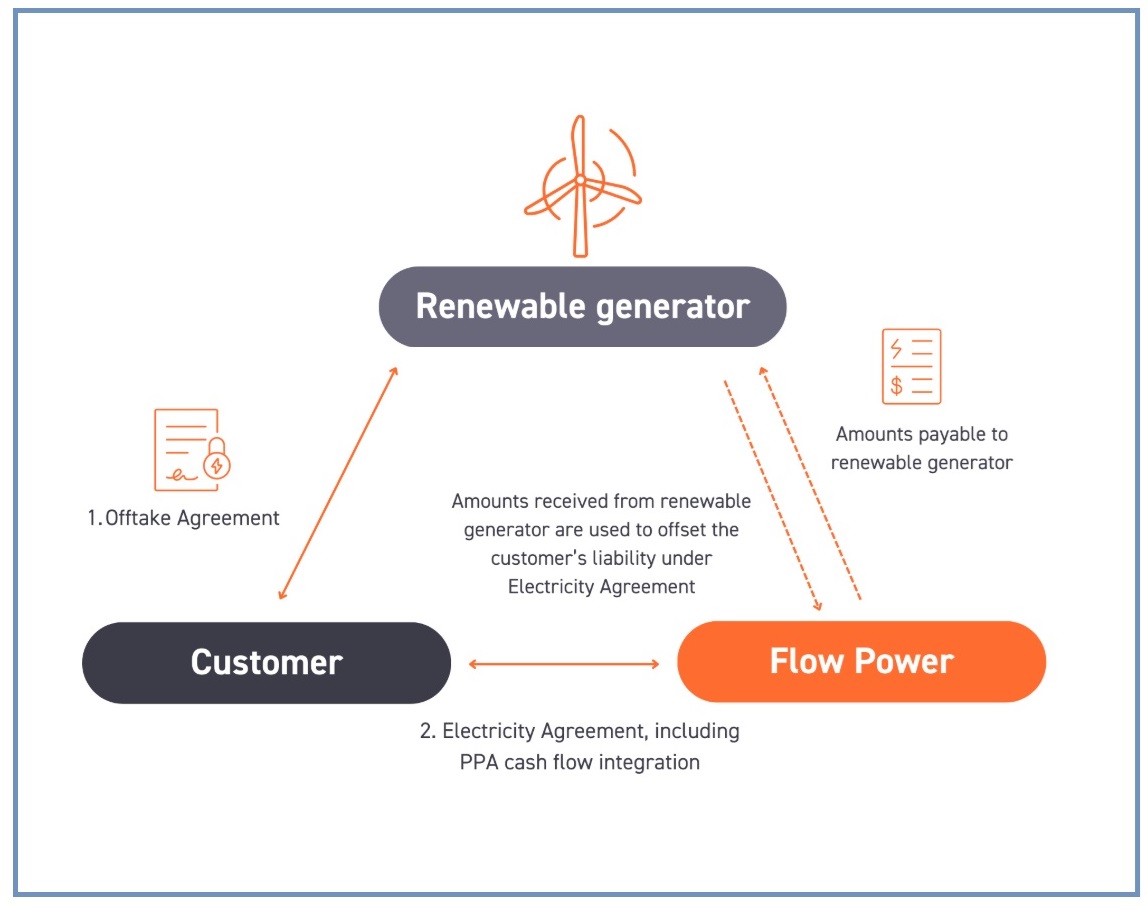
Sleeved PPA. Source: https://flowpower.com.au/sleeved-power-purchase-agreements


A Sleeved PPA is a type of off-site renewable energy deal where a third-party energy provider (usually a utility or energy retailer) acts as the middleman between the company buying the power and the renewable energy generator (like a solar or wind farm). This setup makes energy management easier by letting the intermediary handle all the technical and market-related tasks—like balancing supply, forecasting demand, trading certificates, and managing risks.


How It Works

  • A company signs a contract with an energy supplier (the intermediary).
  • That supplier already has a contract with a renewable energy generator.
  • The supplier buys electricity from the generator and then sells it to the company.
  • The electricity flows through the public grid to reach the company.
  • The company pays the supplier for both the energy and the services; the supplier pays the generator.

Benefits of Sleeved PPA

  • Easy to Manage: The supplier takes care of all the complex energy market stuff, so the company doesn’t have to.
  • Stable Prices: Companies can lock in long-term energy rates, avoiding market price spikes.
  • Boosts Clean Energy: These deals help fund new renewable energy projects that might not happen otherwise.
  • Flexible Setup: Great for companies that can’t install solar panels or wind turbines on-site.
  • One Bill: The company gets a single, simple bill from the supplier for everything.

5. Synthetic or Virtual Power Purchase Agreements (VPPAs)


Synthetic ot VirtualPPA

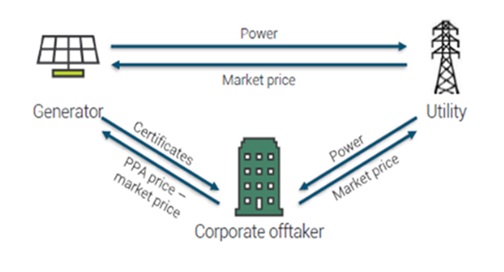
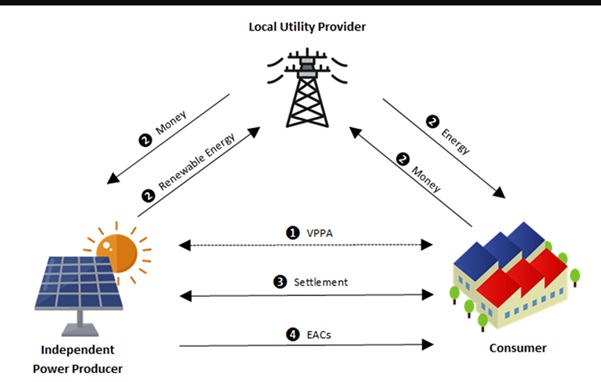
Virtual PPA Virtual Power Purchase Agreements. Source: https://ksandk.com/energy/navigating-legal-considerations-exploring-virtual-power-purchase-agreements/


A Virtual Power Purchase Agreement (VPPA) is a financial deal that lets companies support renewable energy projects—like wind or solar farms—without actually receiving the electricity at their facilities. Instead of physical delivery, it’s all about financial settlements and certificates that prove the energy is green.


How It Works

  • Separate Paths: The renewable generator sells electricity into the wholesale market at the going price. Meanwhile, the company keeps buying its electricity from its local utility as usual.
  • Financial Contract: The company and the generator agree on a fixed “strike price” for a set amount of power over several years.
  • Settlements:
  • If market prices rise above the strike price, the generator pays the difference to the company—protecting the company from price spikes.
  • If market prices fall below the strike price, the company pays the generator—ensuring the project has steady income.
  • Certificates: The company receives Renewable Energy Certificates (RECs) or Guarantees of Origin (GOs), which prove the electricity they’re linked to is renewable.

Benefits of Synthetic or Virtual Power Purchase Agreements

  • No Physical Delivery Needed: The company and the renewable project don’t have to be in the same location—or even the same country.
  • Stable Prices: Acts as a hedge against unpredictable energy markets, giving both sides long-term certainty.
  • Boosts Clean Energy: Helps fund new renewable projects and supports corporate sustainability goals.
  • Flexible Accounting: Often treated as an operating expense rather than a capital investment, making it easier for companies to adopt.

Finally, PPA is not limited to only renewable power sources. It also applies to other sources of power generation such as gas and steam turbine power generators.


Next Article


How the Nigerian Bulk Electricity Trading Plc (NBET) Buys Power: From Procurement Exercise to Power Purchase Agreement

22 November, 2025 at 10:00


Nigeria Bulk Electricity Trading

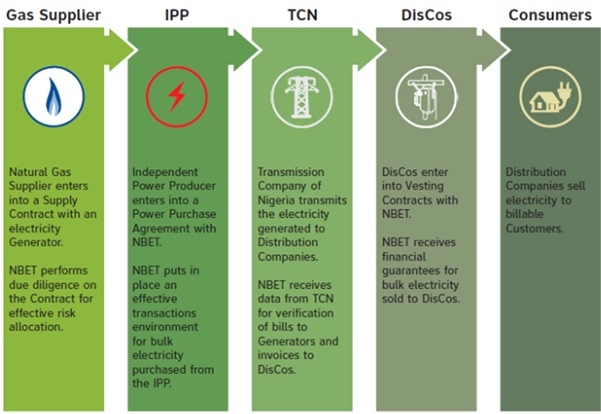
NESI Value Chain: Source: https://nbet.com.ng/nesi.html

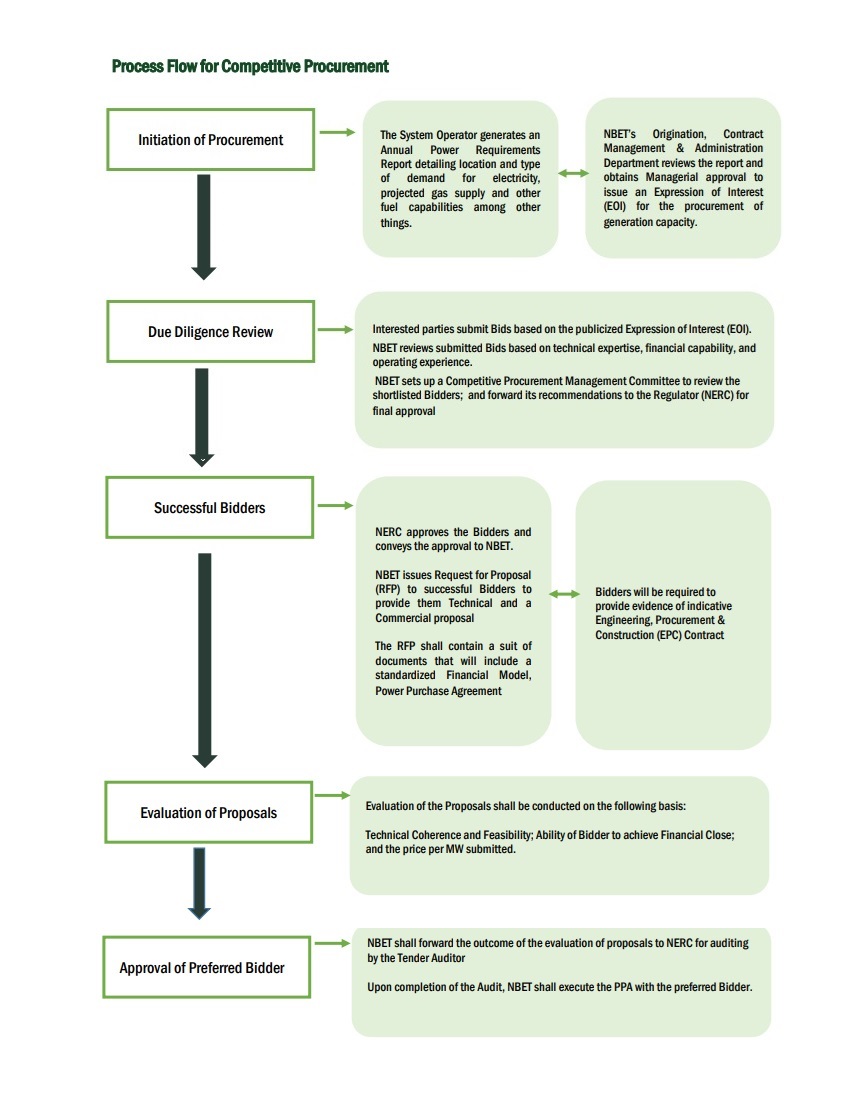
Thinking of investing in Nigeria’s Electricity Supply Industry (NESI)? It is important to understand the procedures that guide the process. Before any power purchase agreement is signed, Nigeria’s electricity procurement journey goes through five essential steps. The journey begins with the NBET, which consults with electricity distribution companies to agree on how tenders (bidding rounds) and contracts will be structured in line with the official Market Rules. Here is a clear outline of those five steps.


Step 1 – Planning the needs

Power System Operations

Power System Operations

Each year, the Nigeria Independent System Operator prepares a report showing:

  • How much new power generation is needed
  • Where electricity demand is located
  • The type of demand (steady base load, medium, or peak demand)
  • The strengths and limits of the transmission network
  • The expected supply of gas and other fuels

Power System Operations

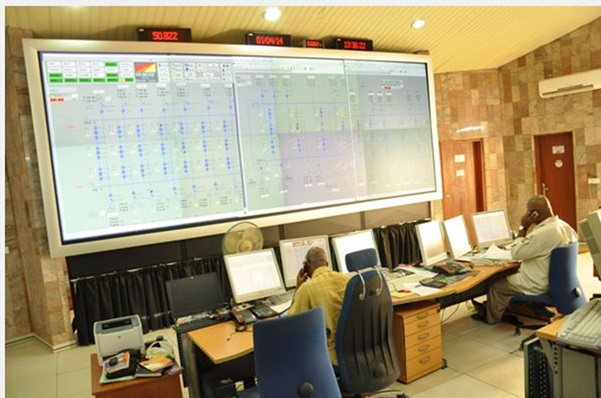
System Operators in the Control Room at NCC Osogbo, Nigeria Source: https://2058-7167.el-alt.com/Pages/ContentPageLink3

Step 2 – Calling for Interest

NBET publishes a notice asking for Expressions of Interest (EOI) from potential developers. This is advertised in:

  • The Federal Government Tenders Journal
  • The World Bank procurement website
  • At least two Nigerian newspapers

Nigeria Energy Summary

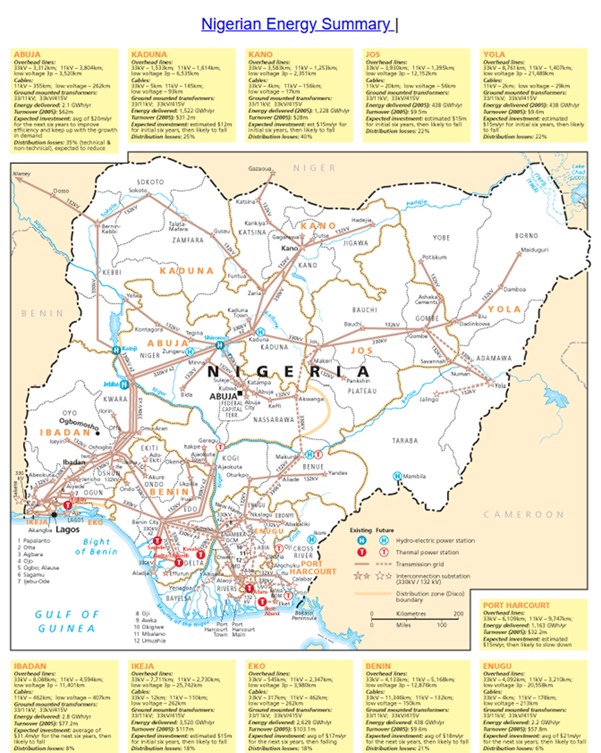
Source: https://www.geni.org/globalenergy/library/national_energy_grid/nigeria/nigeriannationalelectricitygrid.shtml


Step 3 – Reviewing Bids

NBET looks at the submitted bids, checking:

  • Technical expertise
  • Financial strength
  • Past operating experience
After this, NBET issues a formal Request for Proposal (RFP), approved by the regulator (NERC), covering both technical and commercial details.

Typical Distribution Network

Distribution Network Source: https://fgnpowerco.ng/distribution

Step 4 – Selecting Bidders

NBET chooses a Preferred Bidder and a Reserved Bidder.

  • NBET seeks NERC’s approval to sign a Power Purchase Agreement (PPA) with the Preferred Bidder.
  • The Preferred Bidder begins its own tender process for construction, long-term service, and operations contracts.
  • If talks fail with the Preferred Bidder, NBET turns to the Reserved Bidder.

Procurement Process

Process Flow Source: https://nbet.com.ng/pdf/processflow.pdf


Step 5 – Final Agreement

Once both sides agree on the PPA terms, the contract is signed. However, it only becomes effective after the Federal Ministry of Environment reviews and approves the project’s Environmental Impact Assessment Report.


Next Article



The Place of the Nigerian Bulk Electricity Trading Plc in the Nigeria Electricity Supply Industry

18 November, 2025 at 10:00


Nigeria Bulk Electricity Trading

Nigeria Bulk Electricity Trading: Source: https://www.nbet.com.ng/mandate.html

The Nigerian Bulk Electricity Trading Plc (NBET) is Nigeria’s bulk electricity trader whose roles were listed in Electric Power Sector Reform Act of 2005 (Sections 25 and 68) and renewed in the electricity Act, 2023, sections 6f and 7(2)d. The Nigerian Bulk Electricity Trading (NBET) Plc. is the manager and administrator of the electricity pool (‘The Pool’) in the Nigerian electricity supply industry (NESI). Incorporated on July 29, 2010, it is wholly owned by the Federal Government of Nigeria. It is like the middleman that keeps the lights on. It buys electricity in large quantities from different power producers, including the companies that replaced the old Power Holding Company of Nigeria (PHCN), government-owned plants under the NIPP program, independent producers, and even facilities run by international oil companies like Shell and Agip. Once NBET secures this power through agreements with the generators, it resells it to distribution companies, eligible businesses, and even international customers. In this way, NBET acts like the “pool” manager of Nigeria’s electricity market, making sure power flows from where it’s produced to where it’s needed. Its mission is simple:

  • Trade electricity in bulk to stabilize the market.
  • Manage the government’s existing power contracts.
  • Anchor gas supply guarantees to support power generation.
  • And ultimately, move Nigeria electricity market forward.

Next Article


Understanding Service-Based Tariff (SBT)

11 November, 2025 at 09:00


ElectricityMeter 1

Electricity Meter 1: Source: https://www.vanguardngr.com/2024/04/new-electricity-tariff-see-complete-list-of-481-band-a-areas/Aguda, Surulere, Lagos

In Nigeria’s electricity sector, the Service-Based Tariff (SBT) is a pricing system introduced in 2020 by the Nigerian Electricity Regulatory Commission (NERC). Under this system, customers are charged based on how many hours of electricity they receive each day. Instead of paying a flat rate, the amount you pay depends on the quality and duration of power supply provided by your electricity distribution company (DisCo). To make this work, customers are grouped into five categories called service bands—Band A through Band E. Each band has a guaranteed minimum number of supply hours per day. Band A customers get at least 20 hours of electricity daily, while Band B gets a minimum of 16 hours. Band C receives at least 12 hours, Band D gets 8 hours, and Band E gets the lowest, with a minimum of 4 hours per day.

Electricity Meter 2

Electricity Meter 2: Source: https://www.arise.tv/nerc-warns-states-cannot-unilaterally-slash-electricity-tariffs-on-grid-supplied-power/

The pricing is structured so that customers in higher bands—those who receive more electricity—pay higher tariffs. This way, people only pay for the level of service they actually receive. The goal is to protect consumers from being overcharged, encourage DisCos to improve their service, and attract more investment into the power sector to upgrade infrastructure. If you want to know which band you fall into, you can visit your local DisCo’s website or the NERC website. There, you’ll find tools or customer portals where you can enter your account or meter number to see your service band. This system offers several benefits. First, it’s fair—customers are billed according to the actual service they get. Second, it promotes accountability by requiring DisCos to meet minimum service levels to justify their charges. And third, it supports a more sustainable electricity sector by linking revenue to service quality, which can help fund improvements and expansion.


Next Article


The Electricity Distribution Companies (Discos)
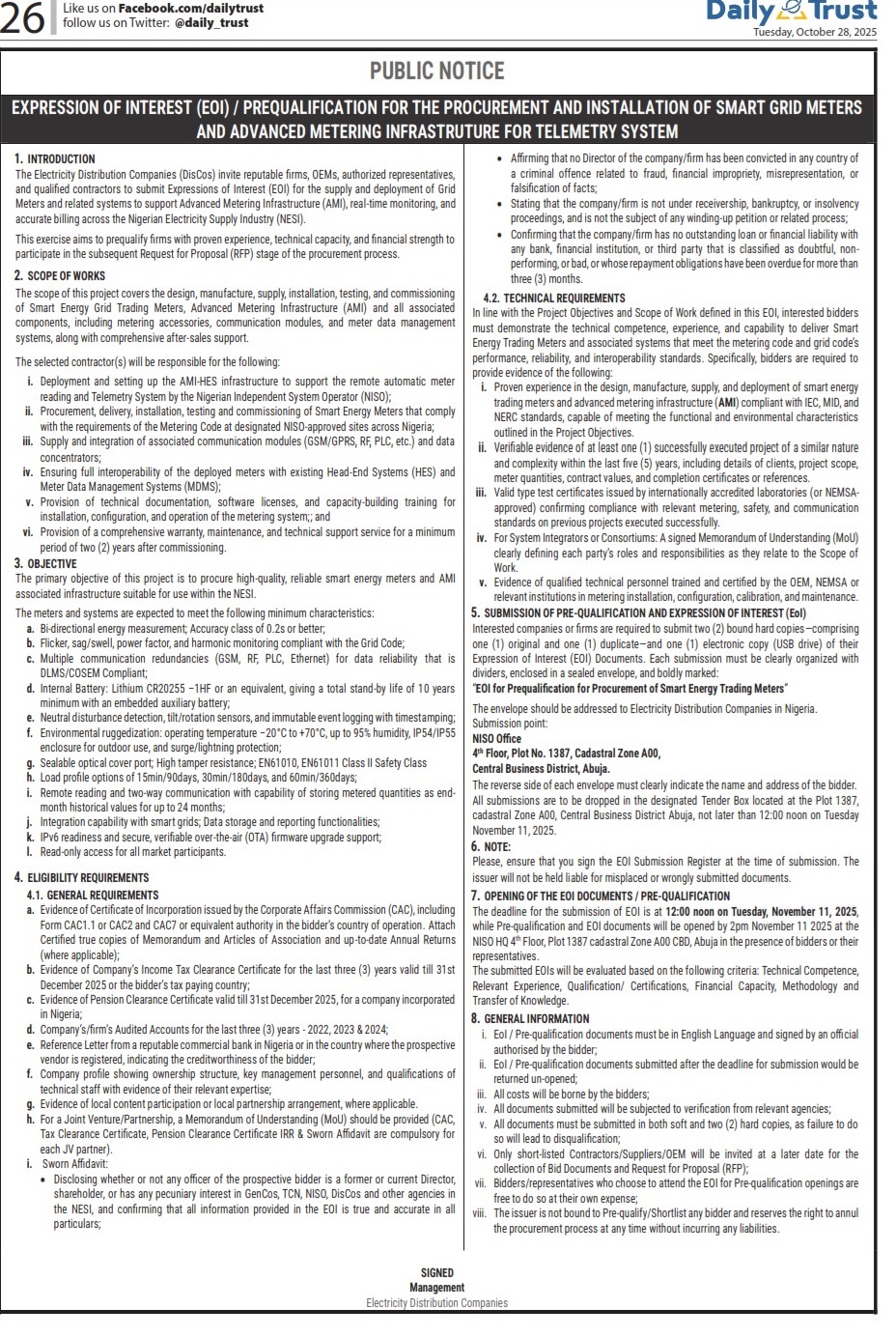
Public Notice: Expression Of Interest (EOI) For Prequalification for the Procurement and Installation of Smart Grid Meters and Advanced Metering Infrastructure for Telemetry System

28 October, 2025 at 08:00


DISCOS Expression of Interest Page

Source: https://ekedp.com/news


Please click the link below to download a pdf copy of the advert:

DISCOS Smart Grid Meters Procurement Advert


Next Article


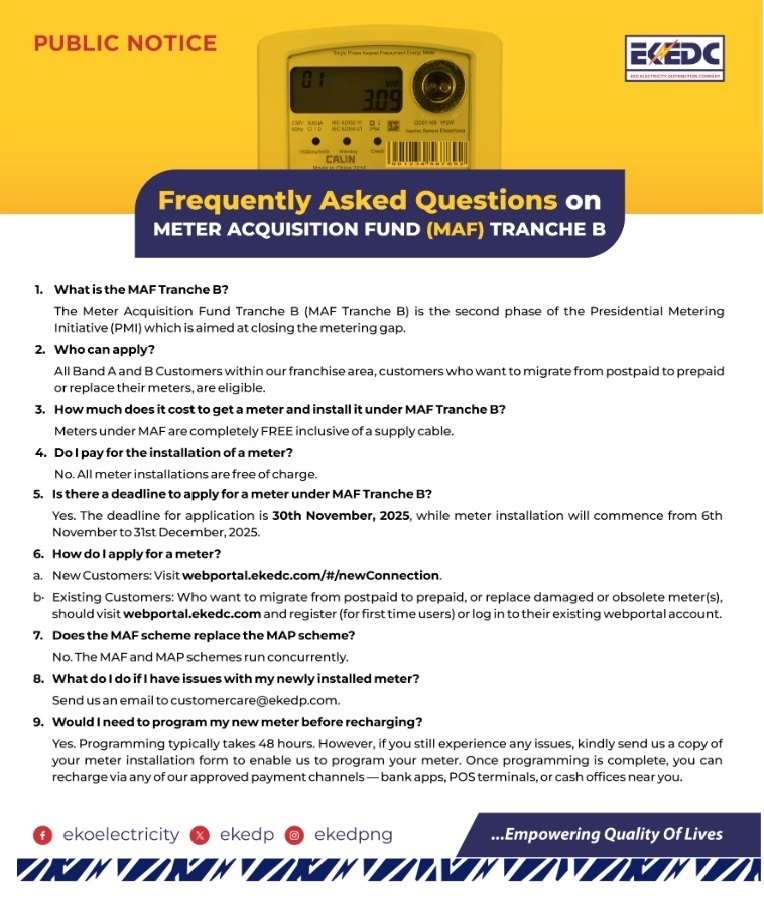
What to know about The Meter Acquisition Fund (MAF) Tranche B – from Eko Electricity Distribution Company

24 October, 2025 at 10:00

Meter Acquisition Fund (MAF) – Tranche B is a Nigerian government initiative, overseen by the Nigerian Electricity Regulation Commission (NERC). It aimed at helping more people get free prepaid electricity meters. It focuses especially on Band A customers and works by providing funds to Distribution Companies so that they can reduce the big metering gap. Below, you’ll find answers to some of the most Frequently Asked Questions (FAQ) about this scheme.


FAQ on Meter Acquisition Funds

Source: https://ekedp.com/news


Next Article


Risk of Violating Electricity Transmission Lines Right-of-Way

24 October, 2025 at 10:00


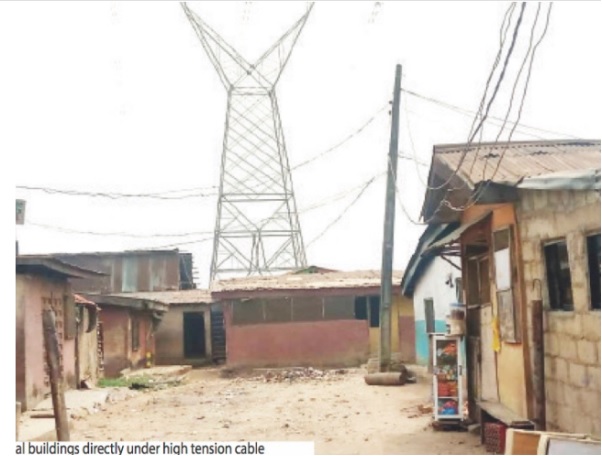
Violation of Right of Way of Electricity Transmission Lines

Aguda, Surulere, Lagos : Source: https://tcn.org.ng/blog_post_sidebar235.php

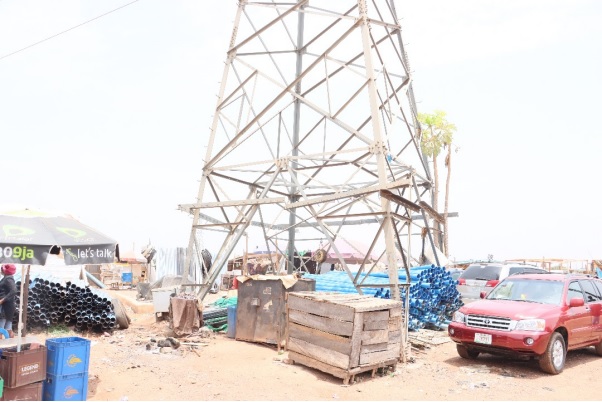
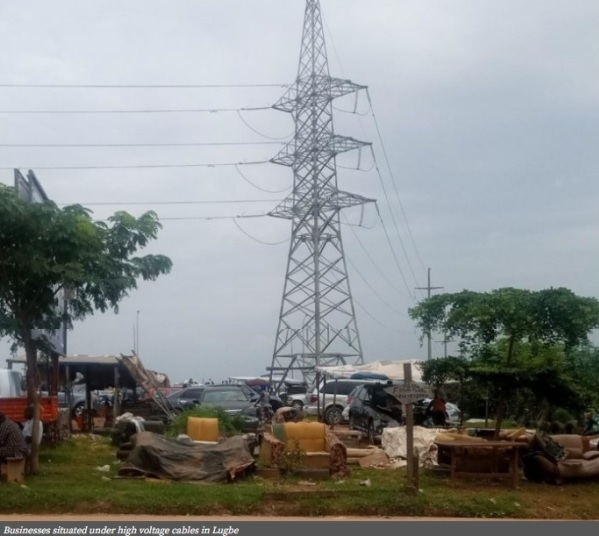
In Nigeria, power transmission lines require a clear and safe buffer zone around them, known as the right-of-way (RoW). This space is legally protected to prevent accidents and ensure the smooth operation of the national electricity grid. However, many people illegally build homes, set up shops, or farm within these zones, putting themselves and the country’s infrastructure at serious risk.

Violation of Right of Way of Electricity Transmission Lines

Ejigbo, Lagos: Source: https://tcn.org.ng/blog_post_sidebar235.php

These violations are driven by several factors. Rapid urban growth and population pressure mean that land is scarce, especially in cities, so development often creeps dangerously close to power lines. In rural areas, many people are unaware of the dangers or the legal restrictions due to low levels of education and poor access to information. Government agencies like the Transmission Company of Nigeria (TCN) and state planning authorities often struggle to enforce the rules consistently, allowing illegal structures to multiply. Compensation for land taken for power lines is sometimes inadequate or poorly managed, which can lead people to reclaim the space illegally. Economic hardship also plays a role—some Nigerians simply have no affordable alternatives and resort to using RoW areas for survival. Public awareness campaigns have been launched, but they haven’t been effective enough to change behavior on a large scale.

Violation of Right of Way of Electricity Transmission Lines

Right of Way Violation: Source: https://thesun.ng/danger-risks/

The law is clear about how much space must be kept clear around power lines. For the highest voltage lines (330kV), 25 meters must be left clear on each side. For 132kV lines, the required distance is 15 meters, and for smaller distribution lines (33kV and 11kV), it’s 5.5 meters on each side. Violating these rules can have deadly consequences. People living or working too close to power lines risk electrocution, especially during storms when cables can snap or electricity can arc through the air. Buildings near power lines can be destroyed if towers collapse or fires break out. Long-term exposure to high-voltage lines has also been linked to serious health issues, including neurological disorders and increased cancer risk. Illegal structures are often demolished by authorities, and the cost of removal is charged to the owners.

Violation of Right of Way of Electricity Transmission Lines

Right of Way Violation: Source: https://www.icirnigeria.org/living-under-high-tension-wires-abuja-residents-gamble-with-death/

For the power sector, these violations cause major problems. They delay important transmission projects, block access for maintenance, and increase the risk of power outages. Unauthorized construction near towers can weaken their foundations, leading to collapse. All of this results in significant economic losses for the country. To combat these issues, Nigerian law provides strict penalties. The Electricity Act of 2023 and other legal frameworks allow for demolition of illegal structures, criminal prosecution, and fines of at least ₦1 million for damaging transmission lines. TCN is working more closely with state governments to enforce these rules. Importantly, the law states that power companies are not responsible for accidents that happen in RoW areas due to illegal construction. In short, protecting the right-of-way around power lines is not just a legal requirement—it’s a matter of public safety, national development, and economic stability.


Next Article



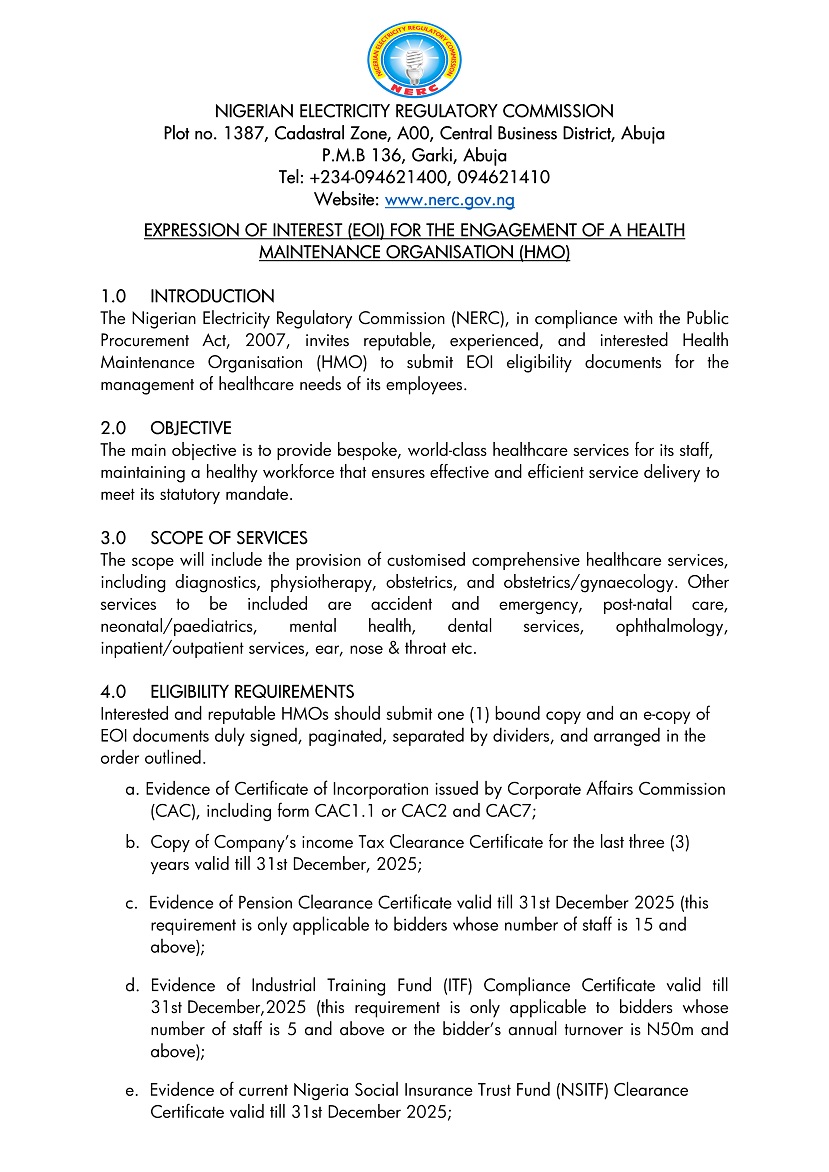
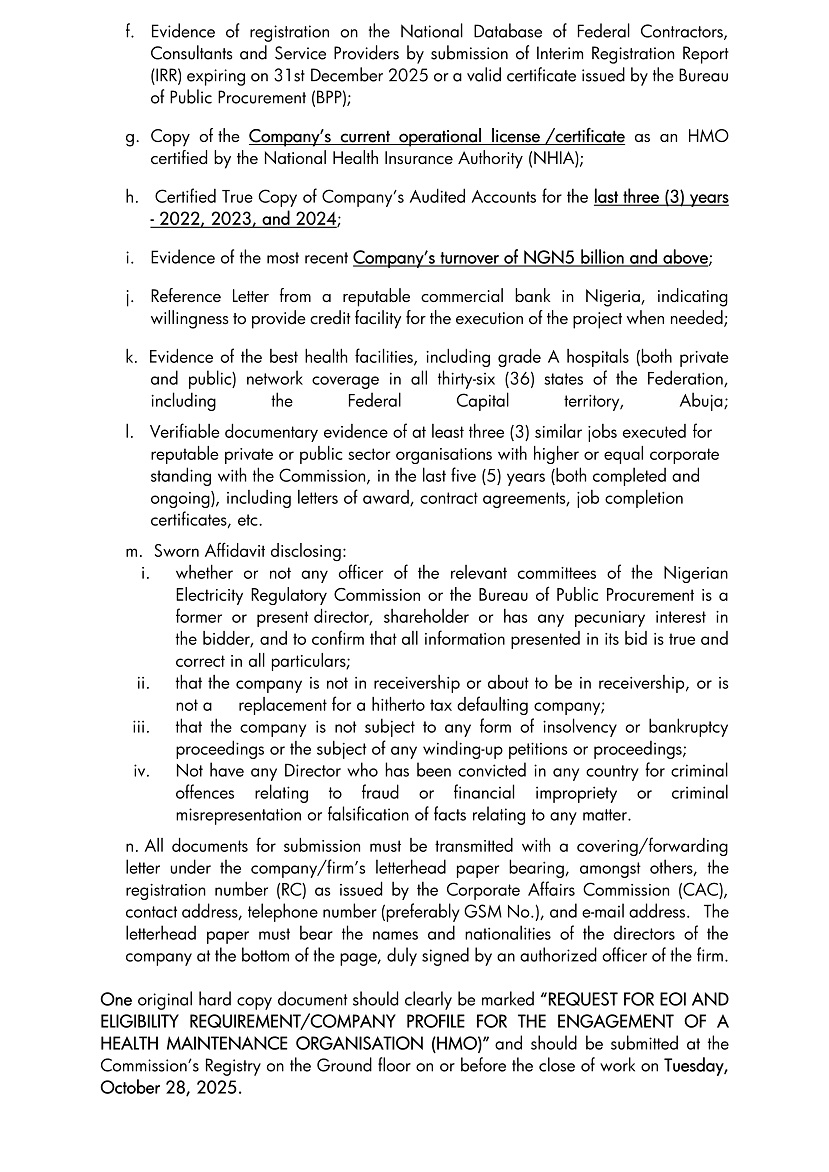
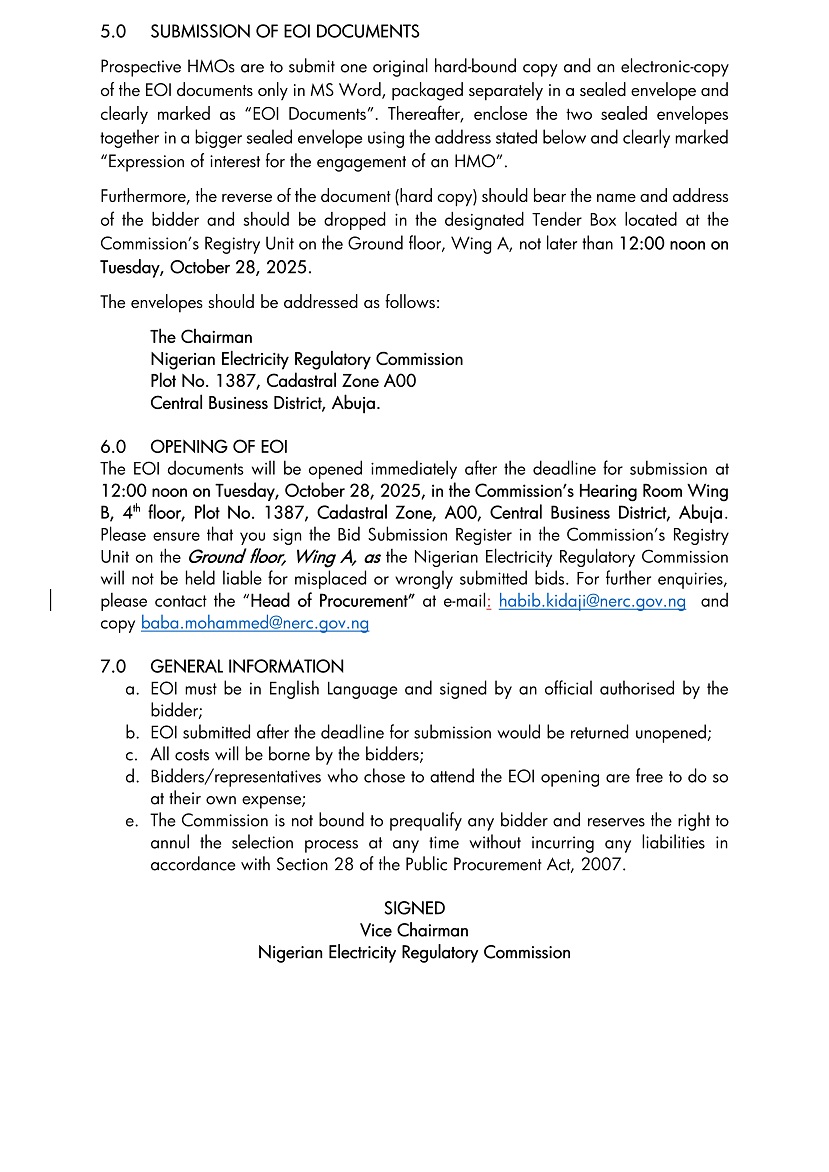
Nigerian Electricity Regulatory Commission: Expression Of Interest (EOI) For The Engagement Of A Health Maintenance Organisation (HMO)

16 October, 2025


NERC Expression of Interest Page 1 NERC Expression of Interest Page 2 NERC Expression of Interest Page 3

Please click the link below to download a pdf copy of the advert:

NERC HMO Advert


Next Article


Minister of Power Commissions Cutting-Edge Training Complex and Hostel at NAPTIN Headquarters

11 September, 2025 at 10:00


Commissioning of NAPTIN Training workshop & Hostels

The Honourable Minister of Power, Chief Adebayo A. Adelabu OFR, FCA, FCIB, commissioning NAPTIN’s block of five modern training workshops and a 104-room hostel complex:

Source: https://power.gov.ng/2025/09/11/minister-of-power-commissions-state-of-the-art-training-workshops-and-104-room-hostel-at-naptin-headquartersA distribution network in Bayelsa State, Nigeria

The Honourable Minister of Power, Chief Adebayo A. Adelabu, has commissioned five modern training workshops and a 104-room hostel at the National Power Training Institute of Nigeria (NAPTIN) in Abuja. Built through collaboration between the Federal Government, EU, and French Government via AFD, the facilities mark a major step in strengthening Nigeria’s power sector workforce. The Hon. Minister described the project as vital for equipping youth with skills to address energy challenges, calling the facilities “investments in our people and the future of Nigeria’s energy transformation.” He acknowledged President Bola Ahmed Tinubu’s support under the Renewed Hope Agenda and thanked international partners for their shared commitment to progress and sustainability. Designed to train engineers, technicians, and leaders with modern tools, the facilities will serve as a hub for innovation and collaboration. The Minister urged stakeholders, especially utility companies, to prioritize NAPTIN for training needs, commended its leadership, and reaffirmed the Ministry’s dedication to expanding infrastructure, employment, and skills development through global partnerships.


Next Article


Transfer of Regulatory Oversight of the Electricity Market in Bayelsa State to BYERA

25 August, 2025 at 10:00


NERC Expression of Interest Page 1

A distribution network in Bayelsa State, Nigeria

According to the updated Nigerian Constitution and the 2023 Electricity Act, the Nigerian Electricity Regulatory Commission (NERC) has decided to hand over control of electricity regulation in Bayelsa State to the Bayelsa State Electricity Regulatory Agency (BYERA). Even with this change, NERC will still be in charge of electricity matters that involve more than one state or other countries—like power generation, transmission, and trading across borders. The law also says that if a state wants to manage its own electricity market within its borders, it must officially inform NERC and ask for the authority to be transferred to its own regulator. As part of this transfer:

  • The Port Harcourt Electricity Distribution Company (PHED) must create a new company (called PHED SubCo) to take over electricity supply and distribution within Bayelsa State.
  • PHED must set up this new company within 60 days from August 21, 2025.
  • The new company must apply for a license from BYERA to operate in Bayelsa State.
All these changes must be completed by February 20, 2026.

NERC Expression of Interest Page 1

How to become a Third-party Collection Service Provider for Nigeria Electricity Distribution Companies a Third-party Collection Service Provider for Nigeria Electricity Distribution ompanies

12 December, 2025 at 10:00


In Nigeria’s electricity sector, third party Collection Service Providers (CSPs) are independent companies that help electricity distribution companies (DisCos) collect payments from customers. They operate under the authority of the Nigerian Electricity Regulatory Commission (NERC) and are guided by the 2025 Guidelines on Registration and Engagement of Third‑Party Collection Service Providers. These rules require CSPs to register formally, follow cashless payment policies, and remain under the joint supervision of NERC and the Central Bank of Nigeria (CBN).


Electricity Distribution Network

Distribution Network Source: https://globalupfront.com/2025/09/10/


Background

DisCos have long faced challenges with revenue collection, including cash leakages, inefficiencies, and customer mistrust. To solve these problems and align with Nigeria’s push toward a cashless economy, CSPs were introduced. Their legal foundation comes from Section 226 of the Electricity Act 2023, which empowers NERC to regulate them. Earlier, in 2019, NERC had already ordered DisCos to move industrial, commercial, and certain residential customers to cashless payment platforms.


Role of CSPs

CSPs act as intermediaries between customers and DisCos. They:

  • Collect electricity bills through approved channels such as banks, fintech apps, POS agents, and mobile money platforms.

  • Provide customers with convenient payment options, reducing reliance on physical cash offices.
  • Ensure compliance by being registered with NERC and licensed by the CBN.
  • Report transaction data to both DisCos and regulators for transparency.
  • Earn service fees, usually a percentage of the collections they process.


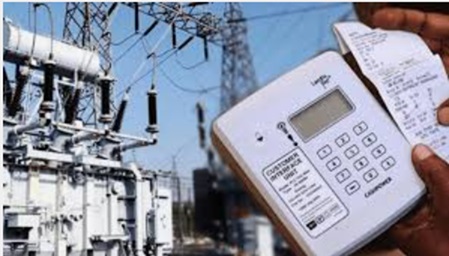
Electricity Metering

Electricity Metering


Registration and Engagement

To operate, CSPs must:

  • Register with NERC before they can be engaged.
  • Be eligible as banks, fintech firms, mobile money operators, or other licensed financial institutions.
  • Go through an approval process where DisCos submit applications to NERC naming their chosen CSPs.
  • Remain under the oversight of NERC (for compliance) and CBN (for financial soundness).
  • Offer multiple collection channels, including online platforms, mobile apps, POS terminals, and agent networks.


CSP Registration in progress

CSP Registration in progress


Benefits

  • For DisCos: Reduced losses, better liquidity, and improved customer trust.
  • For Customers: Easier access to payment options, less dependence on cash, and faster confirmation of payments.
  • For Regulators: Greater transparency and traceability of funds.


Risks and Challenges

  • Fraud risks from unauthorized or unregistered agents.
  • The need for seamless integration between CSP platforms and DisCos’ billing systems.
  • Customer education, since many still prefer cash payments.
  • Strict regulatory compliance, as violations can lead to deregistration.


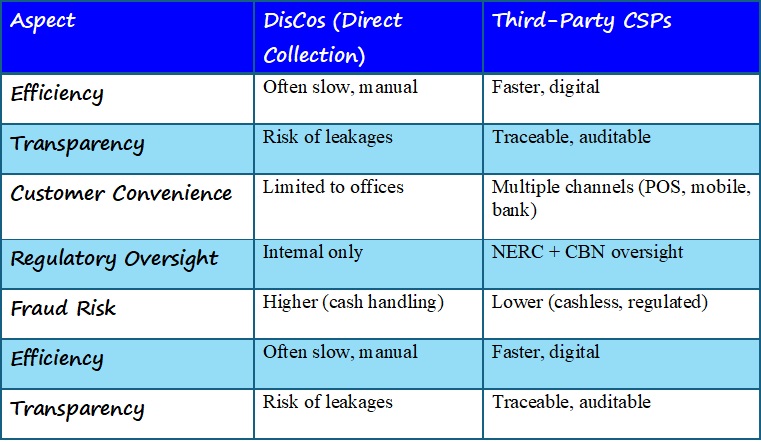
Comparison Table


Comparison Table

Conclusion

Third-party Collection Service Providers are vital partners for Nigeria’s electricity distribution Companies. They make revenue collection more transparent, efficient, and cashless. To succeed, they must be properly registered with NERC and licensed by the CBN. Customers benefit from multiple payment channels, but awareness and trust remain crucial. For DisCos, choosing the right CSP is essential to balance efficiency with compliance and fraud preventionn.


More Articles


TECH. NEWS

TECH. NEWS

TECH. NEWS

Copyright © 2025