
Grid Code Overview
The Grid Code outlines the procedures and principles for the daily management, maintenance, and operation of Nigeria’s Transmission System. It aims to ensure that the system is effective, well-coordinated, and economical, benefiting the entire Nigerian Electricity Supply Industry.
Grid Code Overview
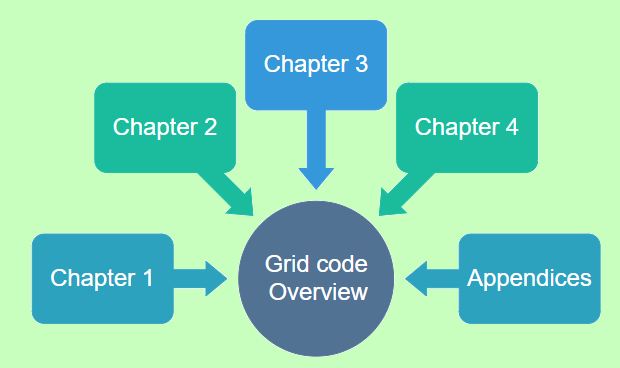
Grid Code has 4 chapters and appendices as depicted in the above diagram
Chapter 1: General Conditions
It comprises 4 sections (Sections 1 to 4) listed below. Among the topics discussed are “Application of the Grid Code”, “Unforeseen circumstances”. “Derogations”, “Review Panel”, “Monitoring, Testing and Investigations”.
 |
Section 1: Background. Section 2: Organisation and Objectives. Section 3: Review Process and Code Disputes. Section 4: Monitoring, Testing and Investigations. |
Chapter 2: Planning
It comprises 4 sections (sections 5 to 8) listed below. Some of the topics discussed are “Long term Demand Forecast”, “Long Term Expansion Plan”, “Standard Planning Data such as “Generating Unit Data”, “Demand and Active Energy Data”, “Transient Over-voltage Assessment Data”, “User’s Protection Data” and “Network Data”.
 |
Section 5: Objectives, Purpose and Scope. Section 6: Load Forecast. Section 7: Expansion Planning. Section 8: Data Requirements for Long Term Planning. |
Chapter 3: Connection Conditions
The chapter has 4 sections (sections 9 to 12) listed below. A few of the topics covered are “ Frequency and Voltage acceptable ranges”, “Grid Connection Agreement”, “SCADA, Measurement and Data Exchange”, “Power System control” and “Protection Criteria and Metering”.
 |
Section 9: Purpose and Scope. |
Chapter 4: Operation
This is the longest chapter comprising 14 sections (sections 13 to 26) listed below. Some of the topics discussed are “ Power System Control Actions”, “Control under fault or emergency conditions”, “System Operation procedures including Fault Reporting”, “Components of Operating Reserve”, “Operating Reserve Procurement”, “Voltage Control, policy, methods and emergencies”, “Ancillary Service”, “Emergency operation, Restoration of supply, Back-up Control Centre”, “Operational communication and data retention”, “Data and Process, Dispatch Scheduling, Outage scheduling, Applicable Reliability Criteria, Scheduling of System Tests and Safety Precautions on High Voltage Equipment”.
 |
Section 13: Purpose and Scope. |
Appendices
There are 9 appendices which are listed below. Among them are “Definitions”, “Data Registration Requirements”, “Distribution Network Data” and “Grid Code Review Panel”.
 |
Appendix 1: Definitions |