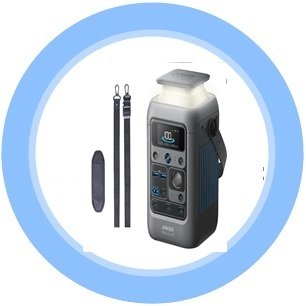
Anker SOLIX C300 DC Portable Power Station with Adjustable Strap,Outdoor 288Wh, Portable Power Station, LiFePO4 Battery, 300W Solar Generator, for Camping, Traveling, and Emergencies.
About this item
- Massive Power on the Go: Take portable power anywhere and deliver 300W and 288Wh to your devices. Fast charge with two 140W two-way USB-C ports.
- 7 Device Charging Ports: Power all your tech with versatile ports, including 1× car socket (120W), 2× USB-C (140W), 1× USB-C (100W), 1× USB-C (15W), and 2× USB-A (12W).
- Go Anywhere Design: Embrace full portability with a 30% smaller design than similar power stations. Attach the strap for more convenience.
- Reduce Shoulder Strain: A unique shoulder pad design increases your comfort and reduces shoulder strain, even when you’re carrying for an extended journey.
- What is in the Box: Anker SOLIX C300 DC Portable Power Station, Adjustable Strap, 60cm 140W USB-C to C charging cable, Safety Manual, and Warranty Info

Front View of Anker Inviter
Detailed Product Review: Anker SOLIX F3800 Portable Power Station
- Anker SOLIX F3800 Portable Power Station:
- Unmatched Dual-Voltage Output: This unit delivers a heavy-duty 6,000W AC output and natively supports both 120V and 240V. Unlike standard portable stations, it runs high-draw household appliances like inverter air conditioners, water pumps, and deep freezers without extra transformers.
- Massive, Expandable Capacity: Built with a base capacity of 3,840Wh, the station can easily run essential household devices through long blackouts. If your energy needs grow, you can stack up to six expansion batteries to reach 26.9kWh, or pair two separate units together for an incredible 12,000W output and 53.8kWh capacity.
- Rapid Solar Recharging: The system features dual solar inputs allowing up to 2,400W of total solar charging. In optimal sunlight, you can fully recharge the massive internal battery in under two hours, giving you a completely off-grid power cycle everyday.
- EV-Grade Lifespan & Stability: Utilizing premium Lithium Iron Phosphate (LiFePO4) chemistry, the battery is rated to last for over 3,000 complete charge cycles. It will deliver reliable daily performance for more than 10 years, backed by an official 5-year warranty from the manufacturer.
- Mobility Meets Home Integration: While it is heavy at 132 lbs, the body is designed like a rolling suitcase with rugged wheels and an ergonomic pull handle for easy movement. For seamless emergency transitions, it can also be wired into your home’s main breaker box using a standard manual transfer switch. Check out the Anker SOLIX F3800 Power Station on Amazon to view current configurations and customer bundle options.
The Pros
- Direct 240V Support: Runs heavy appliances like air conditioners, water pumping machines, and large deep freezers without needing an external step-up transformer.
- Massive Expandability: Starts at a robust 3,840Wh and can scale up to 26.9kWh with expansion batteries, allowing you to build a system that can power a whole house through extended blackouts.
- Rapid Dual Solar Input: Accepts up to 2,400W of solar panel input, allowing it to charge fully in less than 2 hours of good Nigerian sunlight.
- 10-Year Battery Lifespan: Premium LiFePO4 battery cells maintain their health for over 3,000 charge cycles, meaning it will easily last a decade of daily cycling.
- Cleaner, Cheaper Power: Eliminates the ongoing costs of petrol or diesel, removes the stress of fuel scarcity, and operates completely silently.
The Cons
- High Upfront Cost: The initial financial investment is significant compared to buying a standard petrol generator, though it pays for itself over time by eliminating fuel costs.
- Substantial Weight: At 132 lbs (approx. 60 kg), it is quite heavy; while it has wheels for flat surfaces, lifting it up stairs requires two people.
- Solar Panels Sold Separately: To get the full off-grid benefit, buyers will need to spend extra money purchasing compatible solar panels and mounting kits.
- No Real-Time Fuel Backup: Unlike hybrid systems, if you experience consecutive days of heavy rain/cloud cover and a grid collapse simultaneously, you must rely strictly on whatever battery capacity is left.
Buyer’s Guide: How to Calculate Your Home Power Load Before Buying Solar
Buying a solar generator without knowing your home’s power requirements is a quick way to spend too much money or end up with a system that shuts down under overload. To choose the right high-ticket power station for your setup, you need to understand two key metrics: Running Watts and Starting (Surge) Watts.
- Running (Continuous) Watts: The steady amount of power an appliance needs to keep operating normally.
- Starting (Surge) Watts: The brief, intense burst of power an appliance requires to start its motor or compressor. This is common with refrigerators, air conditioners, and water pumps. It can be two to three times higher than the running wattage.
Step-by-Step Load Calculation
Follow this simple formula to determine the minimum capacity your new solar station needs to support:
- List Your Essential Appliances: Identify the absolute essentials you must run during a blackout. Avoid adding non-essential, high-heat appliances like electric kettles or irons, as they drain batteries quickly.
- Find the Wattage Labels: Look for the silver or white specification sticker on the back or bottom of each device. If a sticker lists amps instead of watts, multiply the Amps by the Voltage (220V in Nigeria) to find the wattage (Amps × 220V = Watts).
- Estimate Typical Household Loads: If you cannot find the exact labels, use these common industry estimates for Nigerian households:
- LED Light Bulb: 10 Watts – 15 Watts
- Laptop Charger: 65 Watts – 90 Watts
- Smart TV (55″): 100 Watts – 150 Watts
- Standing Fan: 50 Watts – 80 Watts
- Inverter Refrigerator: 150 Watts (Running) | 400 Watts (Starting)
- 1.5 HP Inverter AC: 1,200 Watts (Running) | 2,500 Watts (Starting)
- Calculate the Total Concurrent Load: Add up the running wattages of all devices you intend to power at the exact same time. Then, find the single appliance with the highest starting wattage and add that surge difference to your total.
- \(\text{Total\ Required\ Output}=(\text{Sum\ of\ All\ Running\ Watts})+(\text{Highest\ Single\ Surge\ Wattage\ Difference})\)
Example Calculation: The Remote Worker’s Household
Let’s calculate the required load for a professional working from home who needs to keep their workspace and basic cooling active simultaneously:
- 5 LED Bulbs (5 × 10W) = 50W
- 2 Laptops (2 × 65W) = 130W
- 1 Standing Fan = 60W
- 1 Smart TV = 120W
- 1 Inverter Refrigerator = 150W (Running) | 400W (Starting)
Total Running Watts: 50 + 130 + 60 + 120 + 150 = 510W
Accounting for Surge: The refrigerator requires an extra 250W to kick on (400W Starting – 150W Running = 250W).
Final Verdict: Your solar generator must have a continuous output of at least 510W and a surge capacity of at least 760W. To protect the longevity of the inverter, add a 20% safety margin. This brings your target requirement to roughly a 700W continuous / 1,000W surge power station.
❓ Frequently Asked Questions (FAQ)
Q1: Can a solar generator really power my whole house, including air conditioners?
Yes, but it depends entirely on the unit’s continuous output wattage and battery capacity. Premium models like the Anker SOLIX F3800 offer a 6,000W output and native 240V support, which is specifically designed to run high-draw appliances like inverter air conditioners, deep freezers, and water pumps. Just ensure the total running watts of your appliances do not exceed the generator’s limit.
Q2: How long will a solar generator last during a prolonged grid collapse?
This depends on your battery capacity (measured in Watt-hours or Wh) and your energy usage. For example, if you are running a total load of 500 Watts on a 4,000Wh battery (like the EcoFlow DELTA Pro 3), the battery will last roughly 8 hours (4000 ÷ 500 = 8). If you pair the unit with solar panels, it will continuously recharge during the day, allowing you to run your essentials indefinitely without relying on NEPA/DisCo supply.
Q3: What happens to my solar power station on rainy or cloudy days?
Solar panels still generate electricity during cloudy or rainy days, but their efficiency drops to about 10% to 25% of their normal output. To handle consecutive days of poor weather, high-ticket solar stations allow you to fast-charge the batteries using public grid power (when available) or a traditional petrol backup generator before the storm hits
Q4: Why should I buy a portable solar generator instead of a custom wall-mounted inverter system?
Portable solar generators offer a true plug-and-play experience. They require zero complex installation, have built-in safety features to prevent battery explosions, and are housed in a mobile, durable casing (often with wheels). If you move to a new apartment or office, you can simply pack up the unit and take it with you, bypassing the expensive rewiring fees associated with traditional wall-mounted inverter setups.
Q5: Are these lithium batteries safe to keep inside my living room or bedroom?
Yes, they are highly safe. Modern premium power stations use LiFePO4 (Lithium Iron Phosphate) battery chemistry, which is far more stable than the older lithium-ion batteries found in smartphones. They do not emit toxic fumes, require zero ventilation, operate quietly, and include built-in Battery Management Systems (BMS) that automatically prevent overheating, short circuits, and overcharging.
👉 Click here to check the Current Price of the Anker SOLIX C300 DC Portable Power Station at Amazon

Anker Recharging

Anker Providing Power Everywhere

Anker, the recommended inverter
👉 Click here to check the Current Price of the Anker SOLIX C300 DC Portable Power Station at Amazon